
A cheap gutter-cleaning quote can become expensive fast if it leaves out clogged downspouts, disposal, difficult access, or basic safety precautions. The right provider is not simply the first result for "find a gutter cleaner near me." It is the one whose scope, access plan, and final price are clear before anyone puts up a ladder.
Use this checklist to narrow down local options, request comparable quotes, and inspect the work with confidence. It applies to routine home maintenance as well as more complex properties with tall roofs, heavy tree cover, or hard-to-reach gutter runs.
Start with the scope: what kind of gutter cleaning do you need?
Before you contact providers, describe the actual job. A one-story bungalow with a few leaves in open gutters is a different project from a two-story home with steep rooflines, gutter guards, compacted debris, and blocked downspouts.
- Identify the property type and height. State whether the property is residential or commercial and how many stories it has. Multi-story buildings, steep roofs, and restricted access may require different equipment, more time, and a more detailed safety plan.
- Estimate the gutter layout. Note the approximate gutter length if you know it, along with detached garages, extensions, conservatories, or separate buildings. You do not need exact measurements, but a provider needs enough detail to avoid guessing.
- Describe debris and visible problems. Mention leaves, pine needles, moss, roof grit, nests, plants growing in gutters, overflow, or signs of water leaking near the foundation. Heavy buildup often takes longer than a routine clean.
- Say whether this is one-time or recurring work. A neglected system may need an initial deep clean, while a tree-covered property may benefit from seasonal visits. Do not assume a maintenance plan is necessary before the provider has seen the conditions.
- Disclose safety-sensitive conditions early. Steep roof pitches, unstable ground, narrow side access, visible gutter damage, nearby power lines, and difficult ladder placement are essential details. Share them before requesting a quote, not when the crew arrives.
Also separate cleaning from other exterior work. Debris removal is not automatically gutter repair, guard installation, roof cleaning, pressure washing, or exterior window washing. If you need any of those services, ask for them as distinct line items.
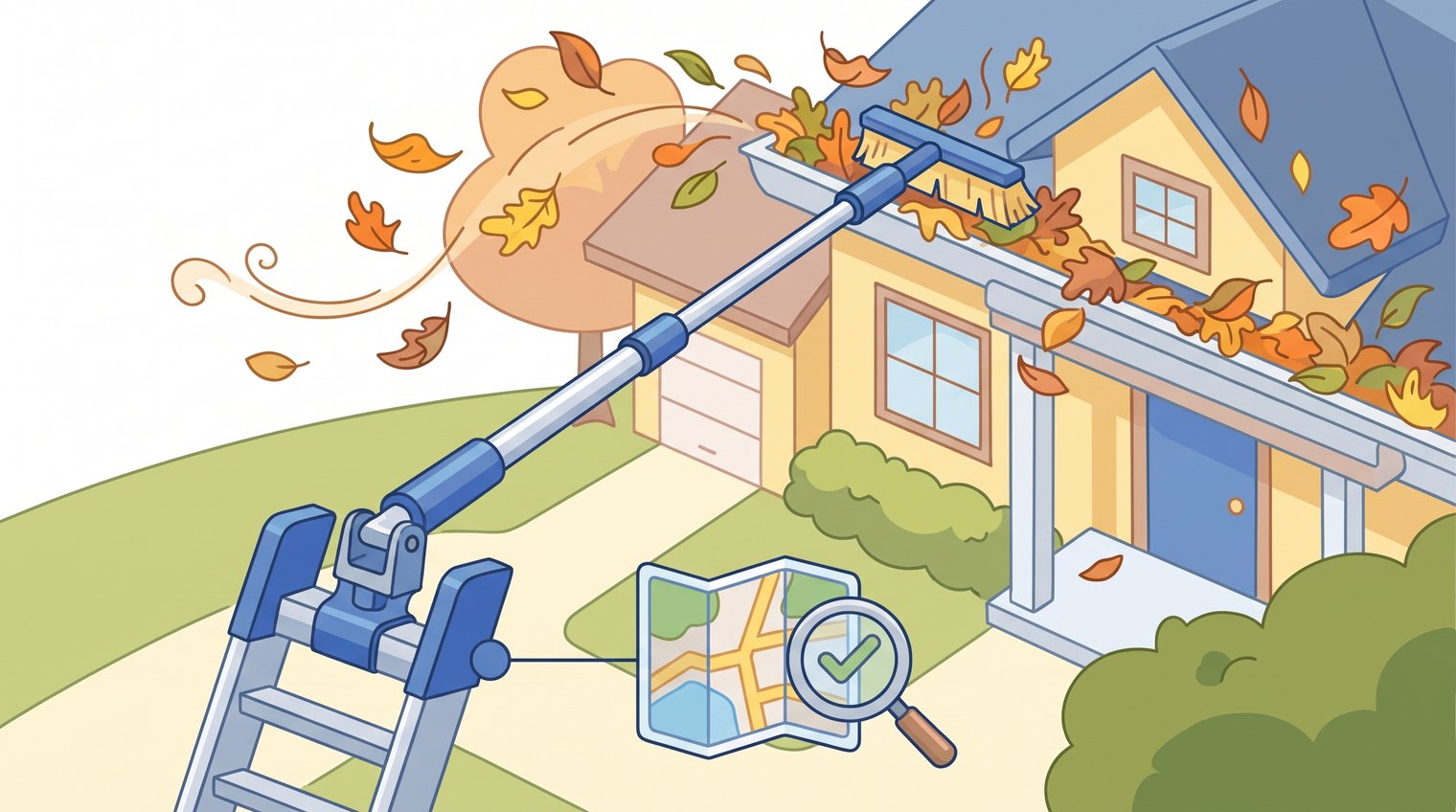
Create a short local provider list before you contact anyone
Start broad, then narrow quickly. Local directories, referrals from neighbors, neighborhood groups, and city-specific searches can all uncover options. The goal is not to contact every company you find; it is to build a shortlist of three providers that clearly serve your address and can explain what they do.
Create a simple scorecard from the beginning. For each provider, record service area, contact details, insurance confirmation, proposed scope, downspout work, total price, extra charges, timing, and review evidence. That makes it much harder for a low headline price to distract you from missing work.
Search by service area, not just by the lowest advertised price
Use your city or neighborhood in the search, then add a useful detail such as "two-story home," "commercial property," or "gutter and downspout cleaning." Confirm that the company serves your exact address before investing time in a long quote request.
A provider located farther away may add a travel fee or have a minimum-service charge. Those terms can make a seemingly inexpensive option more costly than a nearby provider with a straightforward all-in quote.
Use CleanerBook to find local cleaning providers with contact details
CleanerBook is one practical starting point for finding professional cleaning providers by city and accessing their contact details. Use it to build your local list, then contact each business directly to confirm that it offers gutter cleaning and can handle your property's access conditions.
A directory listing is a discovery tool, not proof of insurance, licensing, service quality, or a particular specialty. Verify those details with the provider before booking.

Essential: verify insurance, safety practices, and business legitimacy
This is the must-do stage, particularly for high roofs, second stories, commercial sites, or homes with vehicles, decks, windows, and landscaping below the work area. A fall or dropped equipment can cause serious injury and property damage, so do not treat safety as a vague reassurance.
- Confirm the business identity and working contact details. Get the provider's business name, phone number, and a direct point of contact. A clear identity makes it easier to confirm the agreed work and follow up if there is a problem.
- Request current proof of general liability coverage. Ask directly for documentation rather than relying on an online badge or a profile claim. This is especially important where ladders, roof access, and potential damage to property are involved.
- Ask about workers' compensation where applicable. The relevant requirements vary by location and business structure, but the question is worth asking when a crew will be working at height on your property.
- Confirm a safe access plan. A credible provider should be able to explain how the team will reach the gutter line, work around obstacles, and manage debris without improvising on arrival.
Ask how the crew will access the gutters and protect your property
Ask whether the crew uses ladder stabilizers, whether roof walking is expected, and whether a helper will be present for challenging access. Find out how they will keep ladders away from gutters where possible and how they will avoid damage to siding, windows, decking, plants, and outdoor furniture.
Also ask where debris will go. Some providers bag it for disposal, while others may place it in your green-waste bin if you agree. Vague answers, or pressure to approve work without discussing obvious access hazards, are warning signs.
Ask exactly what the gutter-cleaning service includes
"Gutter cleaning" is not a standardized package. One quote may cover loose debris removal only, while another includes downspout flushing, cleanup, photos, and a basic visual inspection. Get the scope in writing before comparing prices.
- Confirm debris removal from gutter channels. Ask whether the crew will clear all accessible gutter sections or only the areas they can see from a ladder.
- Confirm bagging, disposal, and ground cleanup. Wet leaves and roof grit should not be left in flower beds, on a driveway, or scattered across a patio unless that arrangement was agreed in advance.
- Ask about a visual condition check. Cleaning can reveal loose hangers, sagging sections, seams that leak, or deteriorated guards. A provider can point out problems without automatically performing repairs.
- Clarify how findings will be communicated. Photos and a short written note are useful when gutter lines are not visible safely from the ground.
Does gutter cleaning include downspouts?
Often, but not always. Many providers flush or test downspouts as part of a routine service, while others charge separately for clearing a clog. Ask specifically whether the quote includes downspout testing, flushing, and clearing accessible blockages.
For stubborn clogs, ask what method the provider uses and what happens if the obstruction is in an underground drain connection or another inaccessible section. That work may require different tools and should not be assumed to be included in a standard gutter-cleaning price.
Separate cleaning from repairs and add-ons
Cleaning and repair should be priced separately. Common extras include resecuring loose gutters, replacing hangers, sealing leaks, repairing or installing gutter guards, removing roof debris, and washing exterior surfaces.
Ask the provider to document recommended repairs with photos and a separate price. No additional work should begin just because a crew discovers an issue while cleaning.
Request comparable written quotes from at least three providers
Three written quotes provide a useful local benchmark without turning a basic maintenance job into a weeks-long procurement process. The key is consistency: send each provider the same information and the same photos, so their assumptions are as similar as possible.
- Provide your address and property details. Include the number of stories, approximate gutter length if known, roof shape, gate access, and any detached structures that need cleaning.
- Describe access and debris conditions. Mention steep areas, narrow side passages, heavy leaf cover, guards, visible overflow, and the date of the last cleaning, if known.
- State your downspout concerns. Tell providers whether water is spilling over, downspouts appear blocked, or underground drainage may be involved.
- Send recent photos where safe to take them. Ground-level images of the home, gutter lines, obstructions, and visible debris can improve quote accuracy. Do not climb a ladder just to provide photos.
- Ask for the total price and every expected charge. Request the minimum fee, travel charge, disposal fee, tax, possible add-on rates, and quote expiration date. A quote that cannot explain its final bill is not ready to compare.
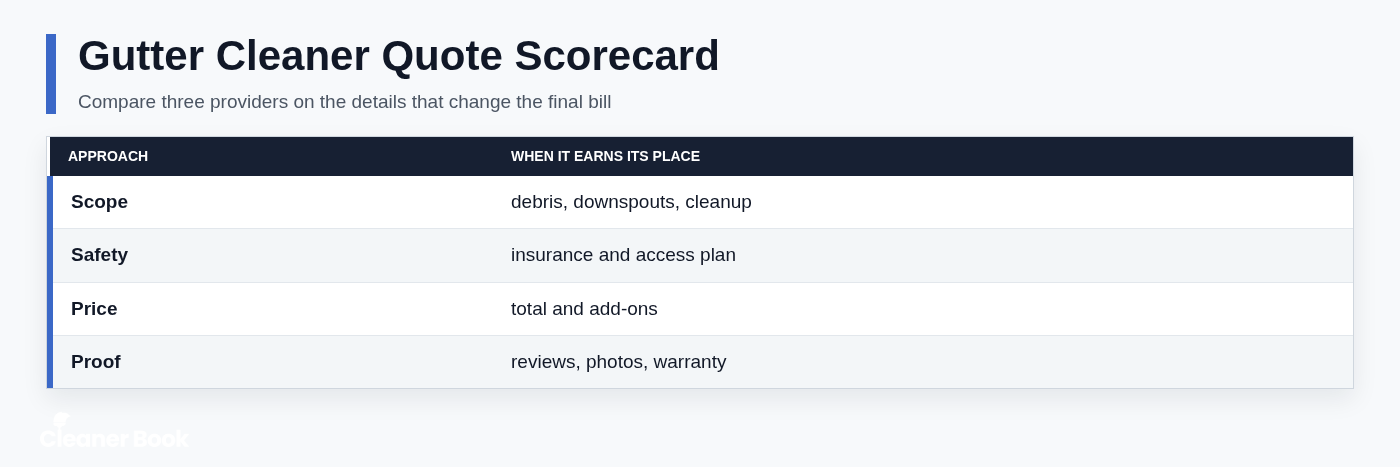
Know what gutter cleaning should cost in your area
There is no universal local price for gutter cleaning. Broad estimates often fall somewhere around $75 to $400, but that range is only an orientation point, not a quote for your property. A small single-story home with light debris is not comparable to a tall property with compacted material, guards, multiple rooflines, and limited ladder access.
The biggest price drivers are usually linear footage, building height, roof pitch, debris volume, gutter condition, downspout work, guard removal or replacement, and access difficulty. Local labor costs and minimum call-out fees matter too.
How to compare an average gutter-cleaning cost locally
Compare three estimates with the same written scope, then identify what could change the invoice. Ask whether the total includes downspouts, cleanup, disposal, travel, and tax, and ask what conditions would trigger an additional charge.
An unusually cheap quote is not automatically a bargain. It may exclude downspout clearing, debris disposal, cleanup, or properly insured labor. The best value is the provider whose scope and price are both easy to understand.
Read reviews for evidence, not just star ratings
Star ratings are a starting point, not a decision. Read recent reviews for evidence that the provider arrives when promised, communicates clearly, leaves the property clean, and handles pricing honestly.
- Look for property-specific details. Reviews mentioning second-story work, heavy leaf buildup, long gutter runs, or difficult access are more relevant than generic praise.
- Check for evidence of care. Useful comments mention protection of landscaping, cleanup of debris, photos of completed work, and respectful treatment of the property.
- Read how complaints were handled. A business can have an occasional issue. What matters is whether it responded clearly and worked toward a fair resolution.
- Prioritize recent, detailed feedback. A handful of credible reviews with useful specifics can tell you more than a large but undifferentiated rating.
Check references, photos, and documentation before booking
For a straightforward, low-cost clean, detailed reviews and a clear quote may be enough. For larger homes, commercial buildings, repair-heavy work, or complicated access, ask for more proof before committing.
- Request before-and-after photos from comparable jobs. Look for work on buildings with a similar height, gutter configuration, and access challenge. Photos should support the provider's claims, not replace a written scope.
- Ask for recent local references when the job is complex. A short conversation with a past customer can help confirm communication, reliability, and price consistency.
- Confirm who will perform the work. Ask whether the business uses its own crew or subcontractors, and who will be your point of contact on the day.
- Get booking terms in writing. Confirm the arrival window, payment method, cancellation policy, weather-delay process, and any workmanship guarantee offered.
A provider who will not put the agreed scope or price basis in writing leaves too much room for disagreement later.
Schedule at the right time - and after the right conditions
For many homes, the best time is after the major autumn leaf drop, when most seasonal debris has landed. A spring clean is also sensible for properties with heavy tree cover, storm debris, blossoms, or winter buildup. Your trees and local weather pattern matter more than a single calendar month.
Do not wait for the perfect season if the system is already showing trouble. Arrange service promptly when gutters overflow, water spills near the foundation, plants are growing from the channels, pests are present, or downspouts are visibly blocked.
Unsafe weather changes the plan. High winds, lightning, icy surfaces, and severe rain create unacceptable risks for ladder and roof work. A reputable provider should reschedule rather than push ahead in hazardous conditions.

Prepare your property and confirm the day-of plan
A few minutes of preparation can help the crew work safely and reduce the chance of avoidable damage or delays.
- Move vehicles, outdoor furniture, and fragile items. Clear the likely ladder and debris-drop areas, especially near driveways, patios, and narrow side paths.
- Secure pets and unlock access points. Keep pets indoors or safely contained, unlock gates, and tell the provider about any access restrictions.
- Point out hazards and delicate areas. Identify overhead lines, irrigation equipment, fragile plants, recently installed landscaping, loose paving, or other concerns before work begins.
- Agree on debris handling. Confirm whether debris will be bagged and removed, placed in an approved bin, or handled another way.
- Confirm communication during the visit. Ask whether an adult needs to be present and how the provider will share photos, report problems, request approval for repairs, or communicate weather delays.
If the crew finds extra work, require a clear price and your approval before it starts.
Inspect the completed job before you pay
You should not climb a ladder or walk on a roof to inspect gutter cleaning. Instead, use safe ground-level checks and ask for documentation of areas you cannot see.
- Confirm the gutters are visibly cleared where accessible. Look for removed leaf buildup and cleaner gutter edges from the ground, without putting yourself at risk.
- Verify downspout testing if it was included. Ask whether each downspout was flushed or tested and whether any blockage or drainage concern was found.
- Check that debris and equipment are gone. Walk around the property to make sure leaves, grit, bags, and tools have not been left behind.
- Inspect gates, plants, decking, windows, and surrounding areas. Note any concern immediately while the crew is still present.
- Request completion photos and written findings. Photos are particularly valuable for upper gutters and roof valleys. Keep them with the invoice and any warranty terms.
These records make future maintenance easier because you will know when the last clean happened and whether the provider identified emerging repairs.
Your quick checklist for hiring a gutter cleaner
Use this condensed list when you are ready to make the call. The first group is essential; the final items are useful improvements once the fundamentals are covered.
- Essential: define the job before requesting quotes. Include property height, access conditions, debris level, gutter guards, downspout concerns, and whether you need a one-time or recurring visit.
- Essential: shortlist at least three local providers. Choose businesses that serve your address and provide clear contact details, rather than selecting the first advertised price.
- Essential: verify insurance and safe-access planning. Request current documentation directly and ask how ladders, roof access, debris, and property protection will be handled.
- Essential: confirm the written scope. Make sure the quote states debris removal, downspout testing or clearing if needed, disposal, cleanup, and any exclusions.
- Essential: compare total prices, not teaser prices. Check minimum fees, travel, disposal, tax, add-ons, and the conditions that could change the final invoice.
- Essential: check review evidence and job documentation. Prioritize recent details about similar homes, communication, cleanup, price reliability, and completed-work photos.
- Essential: inspect safely before paying. Confirm cleanup, request photos of inaccessible sections, and keep the invoice and any warranty details.
- Nice-to-have: plan seasonal maintenance. Many properties need attention after fall leaf drop and sometimes again in spring, depending on nearby trees and storm patterns.
- Nice-to-have: discuss gutter guards separately. Guards can change future maintenance needs, but they are an add-on decision, not a substitute for confirming today's cleaning scope.
If you need a local starting point, use CleanerBook to look for cleaning providers in your city, then contact them directly to confirm gutter-service availability and request a written quote.