Finding cleaners near me is easy. Finding one who can handle your exact property, show up when promised, and deliver the work you expected takes more than clicking the first result.
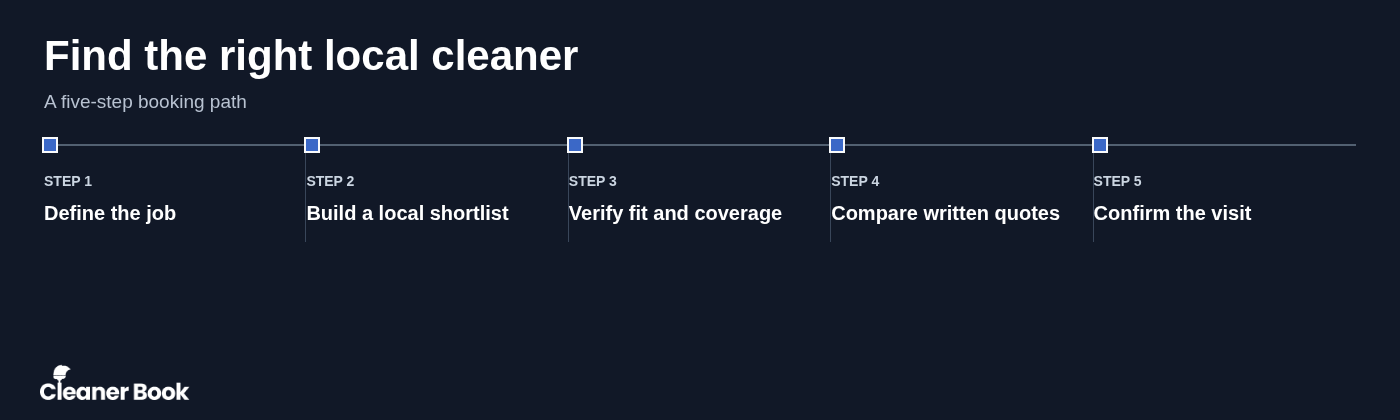
The reliable approach is straightforward: define the job, build a local shortlist, check whether each provider fits the work, compare written quotes on the same scope, and confirm the details before the visit. A weekly apartment clean, a move-out clean, and high-rise window work should never be evaluated the same way.
Start Here: How to Find a Cleaner You Can Trust Nearby
The best cleaner is not simply the closest or the lowest-priced option. It is the provider whose service matches your property, timing, access requirements, and priorities. Before you begin calling companies, decide whether you need routine upkeep, a one-time reset, a specialist service, or a recurring commercial arrangement.
Then search locally using specific terms: your city or neighborhood, the service needed, and the property type. Ask each viable provider for a written estimate based on the same information. That gives you a fair basis for comparison and prevents the common mistake of accepting a low headline price that excludes half the work.
Quick-start checklist for booking local cleaning services
- Define the job: Identify the service type, priority rooms, desired outcome, and whether this is a one-time or recurring visit.
- Gather the essentials: Have your ZIP code or neighborhood, property size, room and bathroom count, preferred date, access details, and must-do tasks ready.
- Build a shortlist: Find three to five local providers that appear to cover your area and service type.
- Verify the fit: Check stated specialties, ask targeted questions, and confirm they can work within your time and access constraints.
- Compare and confirm: Request written quotes, compare inclusions and exclusions, then confirm the appointment and scope in writing.
Decide What Kind of Cleaning Service You Need
A generic request for "cleaning" often produces generic answers. The more accurately you describe the work, the more useful the quote will be. Different jobs require different equipment, staffing, products, timing, and safety planning.
Start by separating routine cleaning from restoration-style work. A home that receives regular maintenance is different from a vacant rental with greasy appliances, a retail store needing nightly service, or exterior windows several stories above ground.
House cleaners near me: recurring, one-time, and deep cleans
When people search for house cleaners near me, they usually need one of three services. A recurring maintenance clean focuses on keeping an already manageable home in order: bathrooms, kitchen surfaces, floors, dusting, and general tidying within the agreed scope.
A one-time clean is useful before guests arrive, after a busy period, or when you want professional help getting the home back to baseline. A deep clean goes further into built-up grime and less frequently handled areas, but do not assume every company defines "deep" the same way. Ask exactly which rooms, fixtures, surfaces, and detail tasks are included.
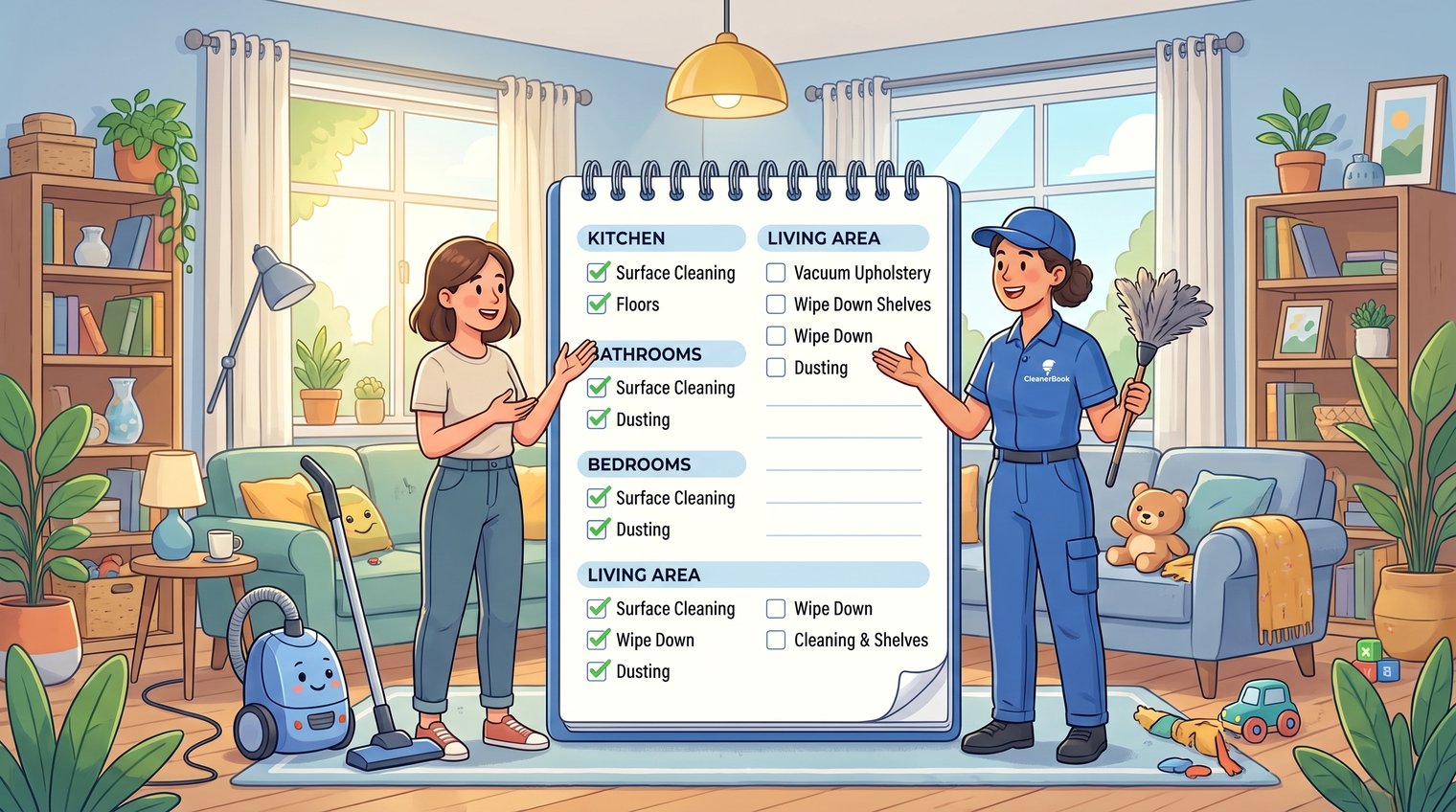
Tell providers about pets, children, heavy pet hair, preferred products, sensitive surfaces, and rooms that need extra attention. If the primary need is the kitchen and two bathrooms, say so. If bedrooms are off-limits, say that too. Specificity makes both pricing and results more predictable.
Move-in, move-out, and post-renovation cleaning
Move-related cleaning needs a room-by-room scope because expectations can be high and the property may be empty. A tenant, landlord, buyer, or seller may care about cabinet interiors, appliance interiors, baseboards, blinds, closets, and marks left behind by furniture. Those tasks should be listed, not assumed.
Post-renovation work is a separate category. Fine construction dust can settle across surfaces, vents, trim, and flooring, while leftover debris may require removal arrangements. Ask whether the estimate includes inside cabinets, inside appliances, wall spot-cleaning, dust removal from detailed surfaces, debris handling, and any return visit for touch-ups.
If a deposit, handover, or opening date depends on the work, save the agreed checklist and appointment messages. Timing matters just as much as the cleaning itself.
Commercial and healthcare cleaning
Commercial cleaning is built around operating needs, not just square footage. Offices may need after-hours cleaning, secure entry procedures, desk and common-area routines, restroom stocking, and dependable coverage when a regular cleaner is unavailable. Retail spaces may need frequent attention to entrances, floors, fitting rooms, and customer-facing surfaces.
Healthcare environments deserve additional scrutiny because site requirements, training, cleaning protocols, and documentation can be central to the agreement. A provider should understand the facility's access rules, approved products, zones, schedules, and reporting expectations. Do not treat a general office-cleaning quote as automatically suitable for a healthcare setting.
Window, roof, and other exterior cleaning specialists
Searches such as window cleaners near me, residential window cleaners near me, and commercial window cleaners near me should lead you toward providers experienced with exterior conditions, not just indoor cleaning. Window work can involve screens, tracks, hard-water marks, delicate panes, limited water access, landscaping, and ladder placement.
For commercial window cleaners near me, access planning is often more important than a broad promise of sparkling glass. Ask how the provider will reach the windows, protect nearby areas, and work around customers, pedestrians, or business hours.
High rise window cleaners near me are a distinct category. Height, building access, fall protection, weather conditions, and site-specific procedures make this a specialized safety decision. The same is true when searching for local roof cleaners near me: roof material, pitch, drainage, vegetation, and cleaning method all affect what is appropriate. Never assume a pressure-based method is suitable for every roof or exterior surface.
Create a Local Shortlist Without Settling for the First Result
A broad search can be a starting point, but it should not be your final decision process. Search using the service plus your city, neighborhood, ZIP code, property type, or specialty. For example, "move-out cleaning in [city]," "commercial janitorial service near [neighborhood]," or "residential window cleaning [ZIP code]" will usually be more useful than a vague search.
Collect three to five plausible options. At this stage, you are not choosing a winner; you are identifying providers with current contact details, a clear service area, and a reasonable chance of meeting the job requirements.
Where to look for local house cleaners and cleaning companies
Local directories, personal referrals, neighborhood groups, property managers, and business listings can each uncover useful candidates. Referrals are valuable because they may reveal how a provider communicates and handles real-world issues, while a directory can help you find specialists outside your immediate circle.
CleanerBook is a local cleaning-service directory where you can search for providers by city and access listed contact details. Use it as one source in your shortlist process, then contact providers directly with the same job description.
For commercial work, ask neighboring businesses, building management, or vendors who operate in the same area. They may know which providers can handle after-hours access, recurring schedules, or a property similar to yours.
How to read service areas, profiles, and reviews critically
A star rating alone does not tell you whether a provider is right for your job. Look for details: recent feedback, repeated comments about punctuality or thoroughness, descriptions of similar work, and how the business responds when a customer raises a problem.
Photos and stated specialties can help, but they are not a substitute for a clear conversation about your property. Check whether the service area truly includes your location and whether the profile distinguishes routine home cleaning from move-out, commercial, window, roof, or other specialty work.
Pay attention to patterns rather than one unusually glowing or negative comment. Repeated praise for reliability is useful. Repeated complaints about missed appointments, surprise charges, or poor communication deserve a direct question before you request a quote.
Verify the Basics Before You Request a Quote
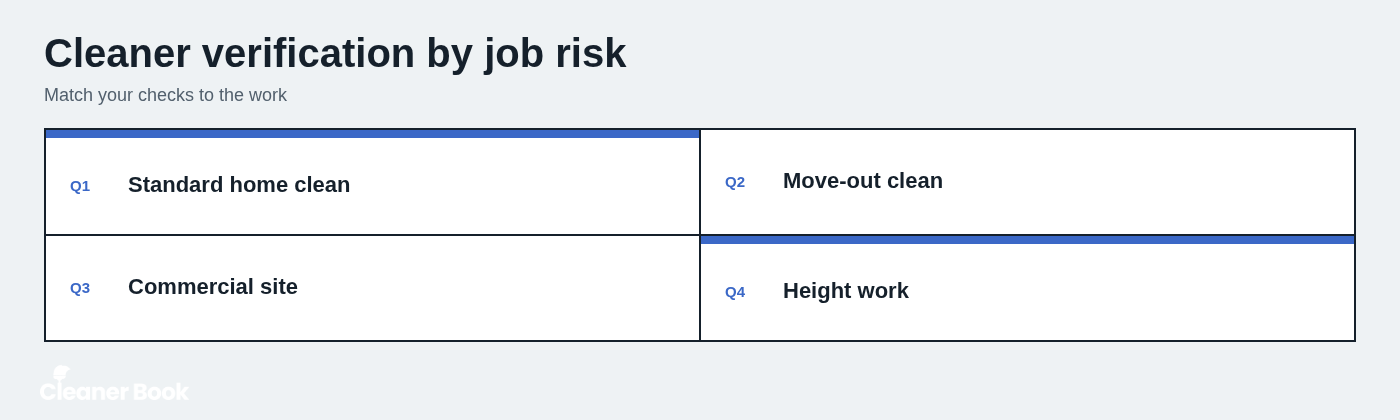
Verification should match the stakes of the job. A standard apartment clean calls for sensible checks around scope, communication, and applicable coverage. A commercial contract, roof cleaning project, or difficult-access window job requires more detailed questions about training, procedures, and risk management.
You are not trying to conduct an audit. You are making sure the provider's capabilities match the work you are asking them to perform.
Insurance, bonding, licensing, and worker status
Terms such as insurance, bonding, and licensing are often used loosely, and requirements vary by location and service type. Rather than assuming every cleaner needs identical credentials, ask practical questions: What coverage applies if property is damaged? What happens if someone is injured while working at the site? How are keys or access codes handled? Are workers employees, independent contractors, or subcontractors?
For a larger or higher-risk job, ask for information relevant to the work before committing. If a provider uses subcontracted workers, clarify who is responsible for the agreed scope, communication, and issue resolution.
Experience, training, and equipment for the job
Broad claims of quality are less useful than specific evidence of fit. If you have natural stone, delicate flooring, antique finishes, extensive pet hair, or a heavily soiled oven, ask what method and products the provider plans to use. A capable cleaner should be able to discuss the job in practical terms.
The same principle applies to commercial and healthcare sites. Ask about experience with comparable environments, relevant training, staffing plans, and the equipment used. For exterior work, ask about water access, cleaning method, surface protection, and how the team will handle the height or layout involved.
Safety checks for ladders, roofs, and high-rise windows
Difficult-access work deserves its own decision process. For ladder work, roofs, and elevated windows, ask how access will be planned, what fall-protection measures are used where appropriate, and whether the provider has experience with the stated height, roof type, or building conditions.
Be clear about obstacles before the appointment: steep grades, locked roof access, fragile landscaping, overhead lines, limited parking, or shared building rules. A provider cannot plan safely around conditions they do not know about.
Ask for Quotes That You Can Actually Compare
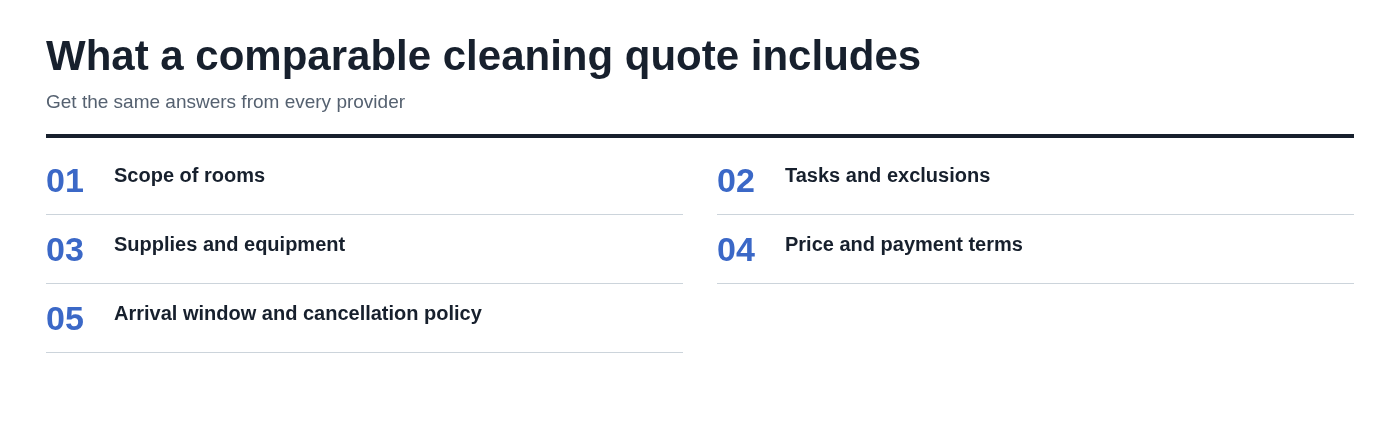
The most important rule when comparing cleaners near me prices is simple: compare like with like. A low quote is meaningless if it covers fewer rooms, skips appliances, excludes supplies, or assumes a property condition far better than reality.
Give each finalist the same information and ask for the estimate in writing. The goal is not to force every cleaner into an identical format. It is to make sure you know what each provider is including, excluding, and charging for.
Information to send every cleaner
A complete request saves time for everyone and improves the chance of an accurate estimate. Include:
- Property address or at least neighborhood and ZIP code
- Home, rental, office, retail, or other property type
- Approximate size, number of rooms, and number of bathrooms
- Current condition and whether the service is recurring, one-time, move-related, or post-renovation
- Priority tasks and any rooms or areas that are off-limits
- Preferred date, arrival timing, and expected frequency
- Pets, parking limitations, building access, stairs, elevator, or gate instructions
- Special surfaces, fragile items, product preferences, or allergy-related concerns
Photos can be useful when there is heavy buildup, renovation dust, unusual access, a large exterior surface, or uncertainty about the condition. A walkthrough may be even better for larger commercial sites, detailed move-out work, and specialty projects where a remote estimate would involve too many assumptions.
Questions that uncover exclusions and add-on charges
Ask direct, neutral questions before you accept an estimate. Is cleaning equipment and product included? Are parking, travel, or building fees separate? What happens if the home has heavy buildup, extensive pet hair, or an unexpected access delay?
Also ask about interior appliances, laundry, interior windows, grout, blinds, and other tasks people often assume are standard. Confirm minimum-hour requirements, cancellation terms, arrival windows, payment timing, and any late-access policy. None of these questions are accusations; they are how you turn a vague quote into a workable agreement.
Understand How Cleaning Services Are Priced
Cleaning companies may price by the hour, by a flat project rate, per room, per square foot, through a recurring plan, or through a specialty-project estimate. There is no universal best model. The right structure depends on whether the scope is routine and predictable or variable and labor-intensive.
Quotes commonly move based on property size, condition, cleaning frequency, labor needed, travel and access, required materials, and risk. An initial visit may cost differently from regular maintenance because it takes longer to bring the space to the agreed standard. Specialty work can also require equipment and planning that a basic home clean does not.
Why the cheapest estimate can cost more later
The lowest number can conceal a scope gap. A quote may exclude supplies, skip detail work you expected, use a short time allowance that does not fit the home's condition, or leave room for add-ons after arrival. An unclear cancellation policy can also become expensive if access or scheduling changes.
Price matters, but it should sit beside reliability, communication, and a documented scope. A slightly higher estimate with a clear checklist, realistic timing, and responsive answers can be the better value because it is less likely to produce a second round of cleaning or an argument over what was promised.
How to set a realistic budget
Start with non-negotiables. If you need the kitchen, bathrooms, floors, and move-out appliances handled before a handover date, make those the base scope. Then ask for optional add-ons such as interior windows, blinds, detailed grout work, or extra rooms.
For recurring service, separate the first appointment from future visits. The first clean may need a more detailed reset, while later appointments can focus on maintenance. That distinction lets you protect the tasks that matter most without expecting every visit to include every possible deep-cleaning detail.
Use a Decision Scorecard to Choose Between Local Cleaners
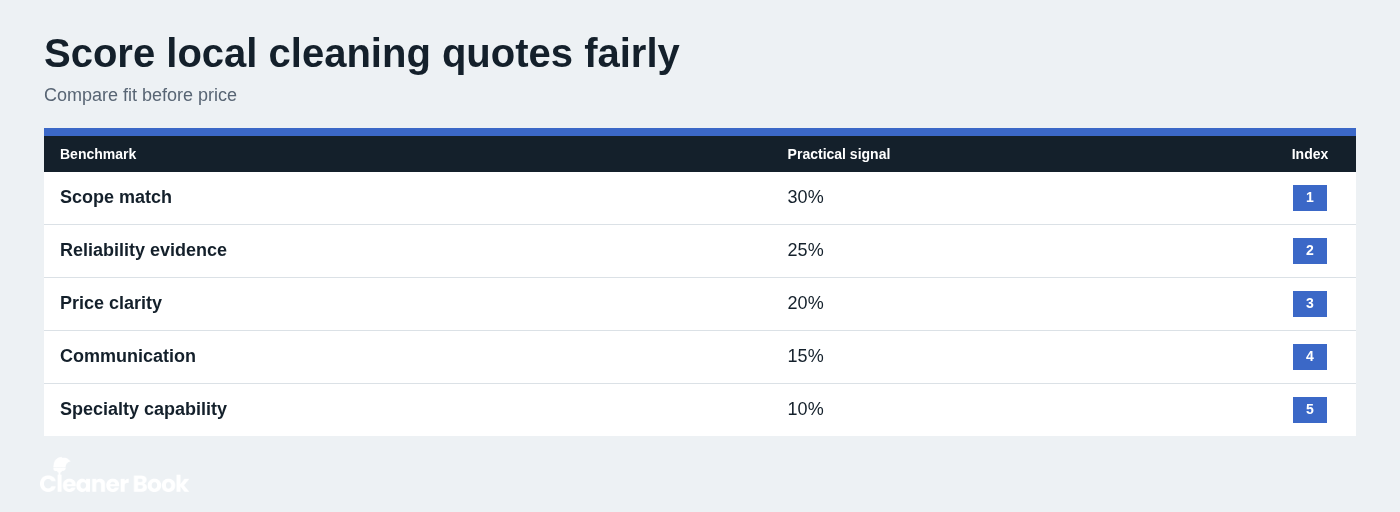
Once you have two or three qualified finalists, a simple scorecard prevents a familiar mistake: choosing based on price because every other difference feels vague. Score only providers that can meet your location, date, and required service type. Anyone who fails a non-negotiable should be removed before scoring begins.
The five criteria that matter most
For most residential jobs, these five criteria create a useful comparison:
- Scope match: Does the estimate cover the tasks, rooms, and condition you described?
- Reliability evidence: Is there credible support for punctuality, consistency, and problem handling?
- Price clarity: Are the total, pricing basis, inclusions, and likely add-ons easy to understand?
- Communication: Does the provider answer questions clearly and respond within a reasonable time?
- Job-specific capability: Do they have the experience, equipment, and safety approach your work requires?
A homeowner may weigh scope match and price clarity heavily. A commercial manager may give more weight to service continuity, site protocols, staffing coverage, and after-hours access. Adjust the weights to fit the actual risk of the decision.
Worked example: choosing among three house-cleaning quotes
Imagine you need a one-time clean of a two-bedroom rental before a move-out inspection. The non-negotiables are an available date, cleaning of the kitchen and two bathrooms, floors throughout, interior oven cleaning, and a written scope.
Provider A has the lowest quote but says oven cleaning and cabinet interiors cost extra, and the written estimate does not list specific rooms. Provider B is mid-priced and provides a checklist covering the requested work, supplies, arrival window, and cancellation terms. Provider C is the highest-priced option and specializes in detailed deep cleans, with a thorough checklist that includes several extras you did not request.
Provider A fails the written-scope requirement, so remove it before scoring. Between B and C, you might score scope match at 30%, reliability evidence at 25%, price clarity at 20%, communication at 15%, and specialty capability at 10%. If B clearly handles every required task and answers questions promptly, B may win even though C offers more detail overall. The point is not to choose the middle price automatically; it is to choose the best fit for the defined job.
Book the Service With a Clear Written Scope
Before the visit, confirm the agreement in writing. It can be an email, message thread, or formal estimate, but it should clearly state the date, arrival window, address, agreed tasks, exclusions, total price or pricing basis, supplies, access instructions, payment terms, cancellation policy, and process for raising a concern.
Save the quote and the relevant messages. This is especially important for move-out jobs, commercial cleaning, and specialty work, where timing or scope disputes can have larger consequences.
Prepare the property for a smoother first visit
Preparation helps a cleaner spend time on the agreed work rather than searching for access or moving personal items. Declutter the main work surfaces where practical, secure valuables, make pet arrangements, provide parking and entry instructions, and point out fragile surfaces or spaces that should not be entered.
That does not mean you should do the cleaner's job before they arrive. You are simply removing avoidable obstacles and making sure the team can start safely and efficiently.
Set up recurring cleaning without losing quality
A recurring service works best with a repeatable checklist. Establish which rooms are handled each visit, preferred products, priority areas, and the communication channel for changes. Keep a short list of periodic tasks, such as baseboards, refrigerator interiors, or detailed bathroom work, so they do not disappear from the routine.
If a team or substitute cleaner may attend, ask how notes are shared between visits. A clear checklist and simple feedback loop protect consistency better than relying on one person's memory.
Handle Problems Professionally if the Clean Falls Short
Not every disappointing result is a service failure. A missed task may be a legitimate issue; a pre-existing mark may not be. Sometimes the problem is an unclear scope, an area that was inaccessible, or an expectation that was never included in the estimate.
Start by comparing what happened with the written agreement. Document the concern promptly, contact the provider calmly, explain the specific gap, and ask what remedy is available under the agreed terms. Keep your messages and any relevant photos.
Document issues in a way that supports a quick resolution
Use a concise list rather than a vague complaint. For example: "The quote included interior oven cleaning, but the oven interior was not addressed," or "The bathroom checklist included floor cleaning, but visible debris remains near the vanity." Time-stamped photos can help where appropriate.
Give the provider a reasonable opportunity to respond or return, provided that is practical and consistent with the agreement. Clear documentation is useful because it separates missed work from disagreements about scope and makes a quick resolution more likely.
Special Considerations for Commercial Cleaning Contracts
Commercial cleaning is a service relationship, not just a series of individual visits. Office managers and facility decision-makers need dependable staffing, predictable quality, security controls, and a clear way to escalate problems. The contract should reflect how the building actually operates.
Build a site-specific scope and quality-control routine
Divide the site into zones: entrances, reception, workspaces, restrooms, break areas, storage areas, floors, and waste points. Define the frequency for each zone, who supplies consumables, when inspections occur, and how issues are reported.
For healthcare cleaners, documented processes and site-specific requirements deserve even closer attention. Cleaning expectations may vary by room type, access level, product restrictions, and facility procedures. Make those requirements part of the written scope rather than relying on a general description of "sanitizing."
Avoid common contract gaps
Compare contracts using the same scorecard approach used for quotes: check service frequency, staffing continuity, consumables, inspection routines, escalation contacts, and the written process for missed work. Confirm notice periods, price-change terms, and termination conditions before signing so both sides understand how the arrangement can change or end.
Final booking checklist
Before booking, confirm the provider, written scope, schedule, total price or pricing basis, access instructions, supplies, cancellation terms, and contact for questions or problems. For recurring commercial work, also confirm the inspection and escalation process.